TL;DR: After a hurricane, your insurance policy is usually the main source of money for roof repair, so how you document and file matters more than how fast you sign a contractor. Photograph everything before you touch it, report the claim to your insurer in writing, make only reasonable temporary repairs, and keep receipts. Florida law gives you an outer limit of 1 year to give notice of a claim and 18 months for a supplemental claim, counted from landfall, but waiting is a mistake. Be wary of anyone who says insurance will "cover" a roof, offers to handle your deductible, or wants you to sign over control of your claim.
The direct answer
Do these in order. First, make everyone safe and photograph the damage. Second, notify your insurer, in writing if you can, and note the date and claim number. Third, stop further damage with reasonable temporary repairs and keep every receipt. Fourth, meet the adjuster, bring your photos, and ask for the estimate in writing. Fifth, get licensed contractors' written repair scopes before you decide anything. [judgment]
Florida Statute 627.70132 sets the outer limits: notice of a claim or reopened claim within 1 year after the date of loss, and notice of a supplemental claim within 18 months after the date of loss. For a hurricane, the date of loss is the date the hurricane made landfall. [code] (Fla. Stat. 627.70132)
This page is general information, not legal or claims advice. For a disputed or large claim, a licensed Florida attorney or public adjuster can look at your actual policy.
Key facts
What it is
The claim in plain terms
A homeowners policy pays for covered physical damage, minus your deductible, up to policy limits. A hurricane roof claim is you telling the insurer what was damaged, the insurer inspecting, and the insurer paying or denying all or part of it. The payment depends on your policy's terms: whether it pays replacement cost or actual cash value, how the roof deductible works, and what is excluded (flood, for example, is not covered by a standard homeowners policy and needs separate flood coverage). [judgment]
Florida Statute 627.7011(3) describes the payment mechanics for dwellings: the insurer must initially pay at least the actual cash value of the insured loss, less any applicable deductible. It also says that where a roof deductible applies, the insurer may limit the roof payment to actual cash value until it receives reasonable proof that you have paid the roof deductible. [code] (Fla. Stat. 627.7011) Whether your policy uses a separate hurricane deductible is set by the policy, not by the statute.
Law and ordinance coverage
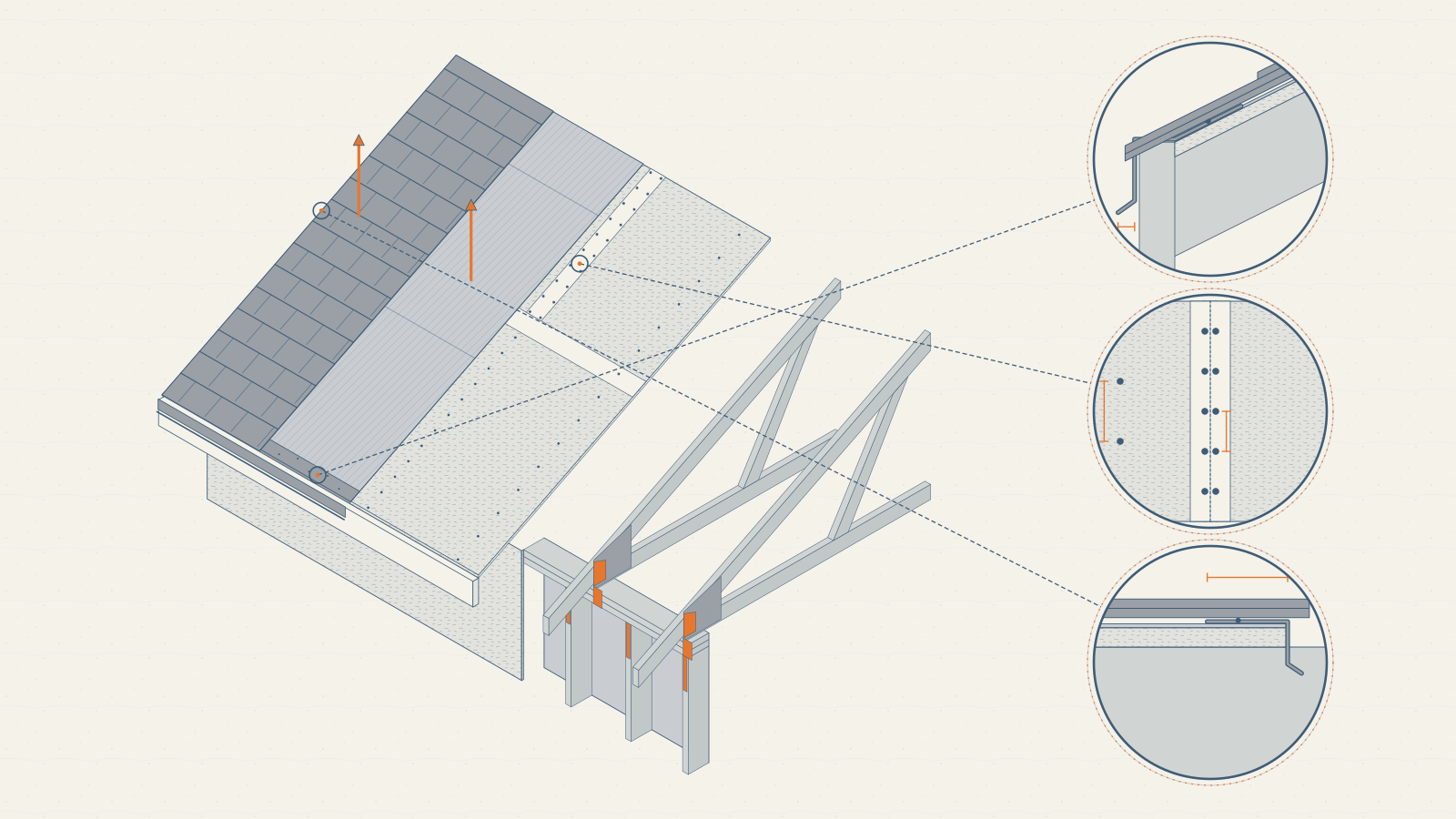
When code requires more than the old roof had, the extra cost is a "law and ordinance" item. Section 627.7011(2) says that, unless you refuse it in writing, the policy is deemed to include law and ordinance coverage limited to 25 percent of the dwelling limit. [code] (Fla. Stat. 627.7011) Confirm against your declarations page. See Florida's reroof requirements for secondary water barriers and deck attachment.
How it's done: the steps
1. Document before you change anything
- Photograph and video every side of the house from the ground, then each damaged area. Include wide shots that show location and close shots that show the damage.
- Photograph interior water stains and wet insulation, ceilings, and belongings before moving them.
- Keep a dated list of damaged items and a log of every call, with names and times.
- Do not climb onto a damaged roof. A drone photo or a licensed contractor's inspection is safer.
[judgment]
Check your policy's duties-after-loss section and your insurer's instructions on when to photograph and what to keep. [judgment]
2. Notify your insurer
Report the loss by the method your policy and insurer specify, and follow up in writing. The statute gives the insurer 7 calendar days to review and acknowledge receipt of a claim communication, unless payment is made in that period or circumstances beyond its control prevent it. [code] (Fla. Stat. 627.70131(1)(a)) Keep the confirmation. If you cannot reach the insurer, keep a record of every attempt.
3. Protect the property, with receipts
Most policies require reasonable steps to prevent further damage. Tarps, plywood, and emergency drying are the usual examples. Many policies reimburse reasonable temporary-repair costs, but your policy decides. [judgment] Use the least invasive fix, take "after" photos, and get an itemized receipt. Be careful with any emergency contract that has a long authorization to "handle your claim."
4. The adjuster visit
Be there. Show the adjuster everything you photographed, including interior leaks. Ask for the written estimate: the statute says the insurer must send you a copy of any detailed loss estimate within 7 days after its adjuster generates it, though it need not create one if one is not reasonably necessary. [code] The physical inspection is to occur within 30 days after proof-of-loss statements are received, and the pay-or-deny deadline is 60 days after notice of the claim. [code]
5. Compare with a contractor's scope
A licensed roofer can write an itemized scope: the area, the roof deck condition, flashing, underlayment, permits, code-required items. Compare it line by line with the insurer's estimate and point out differences in writing. The contractor can document and estimate; arguing coverage is not their role (see below).
6. Hidden damage and supplements
Damage found when the old roof comes off, such as rotten decking, is the classic supplemental claim. Stop and document before it is covered. Send the evidence and the contractor's itemized change in writing. Supplemental claims have their own 18-month limit. [code]
Contractor-fraud red flags
Section 489.147(2) says a contractor may not, directly or indirectly:
- offer a rebate, gift, gift card, cash, coupon, waiver of any insurance deductible, or other thing of value in exchange for allowing a roof inspection or making a roof damage claim
[code] - interpret policy provisions, advise an insured about coverages or duties, or adjust a property insurance claim for the insured, unless licensed as a public adjuster under part VI of chapter 626
[code] - offer, pay, receive, or accept compensation for referring services that insurance proceeds would cover (payment for the roofing work itself is not a referral fee)
[code] - give an insured a repair authorization without a good-faith, itemized, detailed cost estimate
[code] - solicit you with a written or electronic communication that encourages you to contact a contractor or public adjuster about a roof damage claim without three required statements: that you are responsible for paying your deductible; that knowingly or willfully waiving, rebating, or paying all or part of a deductible with intent to defraud is a third-degree felony; and that intentionally filing a claim with false, incomplete, or misleading information is a third-degree felony
[code]
A contractor who violates the section is subject to disciplinary proceedings and may be fined up to $10,000 per violation. An unlicensed person who commits a prohibited act is guilty of unlicensed contracting and may be fined up to $10,000 per violation. [code] (Fla. Stat. 489.147)
Practical warning signs, from the statute and the state consumer guide: [guide]
- "Insurance will pay for a new roof because yours is old." Coverage depends on storm damage and your policy; age alone is not a claim.
[judgment] - "We'll cover your deductible," "services at no charge," or "pay it back later." The state consumer guide lists a promise of services at no charge or a deductible waiver among its red flags.
- A Direction to Pay or similar agreement. The guide says it may have the insurer pay the contractor directly, sometimes before the work is complete, that you are not required to sign one to have work done, and that you should watch for language letting a contractor submit claims to or ask for payment from your insurer without consulting you.
- A contractor who shows up unsolicited and points out damage you have not noticed, offers a gift card or payment for a free inspection, or pressures you to file an insurance claim.
- No valid and active Florida license, unwillingness to show certificates of general liability and workers' compensation insurance, no references, or a contact point that is a motel, P.O. box, work truck or work trailer.
- A request for full payment up front or payment in cash only. The guide says an advance payment should never be more than 50 percent of the full price, and that you should not make final payment until all work in the contract is complete.
- Blank spaces in a contract, or no copy of what you sign before work begins.
The guide is the Florida Insurance Consumer Advocate and APCIA consumer guide Don't Be a Victim! Prevent Contractor Fraud and Abuse (undated). It also says to let your insurer inspect before you sign paperwork or a contractor starts work. It states that by law you can cancel a contract to replace or repair a roof, without penalty, within 10 days after the contract is executed or work starts, whichever comes first, for contracts entered into after a declared state of emergency, and that contractors must include cancellation rights in the contract or an attachment. We did not read the statute behind that cancellation right, so confirm the terms in your own contract. [guide]
Verify a contractor's license at MyFloridaLicense.com, and verify workers' compensation coverage or an exemption through the state's online portals; the guide also tells you to confirm that the contract says the contractor will obtain the necessary permits. [guide]
Where to report. The guide lists the Department of Financial Services Criminal Investigations Division for insurance fraud, at 1 (800) 378-0445 or MyFloridaCFO.com/Division/CID, and the Department of Business and Professional Regulation for suspected unlicensed activity, at (850) 487-1395 or MyFloridaLicense.com. The guide is undated, so confirm the numbers on the agencies' sites before relying on them. [guide]
Cost profile
A claim has no installation price, but it has costs: the deductible (set by your policy), temporary repairs you advance, and, if you hire one, a public adjuster's fee (set by their contract). We do not give dollar figures; ask for each in writing. [judgment]
Where it fits, and where it doesn't
- Fits: a homeowner with wind damage who wants the right order of operations and knows what a contractor may not do.
- Does not fit: flood-only damage (use your flood policy and see flood zones); disputes already in litigation; commercial properties.
- Federal aid is separate. FEMA announced an emergency declaration for Florida for Hurricane Isaias, covering 27 counties including Escambia, Santa Rosa, Okaloosa and Walton, with emergency protective measures limited to direct federal assistance at 75 percent federal funding
[news] (FOX 10). On October 14, 2026, Escambia County said no determination had been made on individual FEMA assistance, and Santa Rosa County said individual assistance was not yet available and that the current federal declaration covers government response costs only. Reporting damage to a county portal does not itself apply for or guarantee FEMA aid [news] (WEAR/ABC News 4). FEMA's "current disasters" page, checked October 27, 2026, did not list a Florida entry, so check fema.gov for current status. Declarations change quickly. Insurance is the lever you control now.
Objections, and when we don't recommend it
- "My insurer will treat me fairly, I don't need documentation." Most do, but a claim is a documented request. The cost of photos is nothing.
[judgment] - "A public adjuster is always worth it." Not always. Read the fee terms and scope; for a small, clear claim you may not need one.
[judgment] - When we don't recommend it: signing a contract before you have the insurer's estimate and a written scope; letting a contractor communicate with the insurer about coverage; starting permanent repairs before the adjuster sees the damage; relying on a social-media post for your deadline instead of the statute and your policy.
- Assignment of benefits. Under s. 627.7152(13), a policyholder may not assign post-loss benefits under a residential property policy issued on or after January 1, 2023 (subject to the exception in subsection (11)), and an attempted assignment is void, invalid, and unenforceable.
[code] (Fla. Stat. 627.7152) Check your policy's issue date.
Availability and installer notes
Post-storm demand slows contractors and adjusters alike. Ask any roofer for their license number, proof of liability and workers' compensation insurance, a written itemized scope, a permit plan, and references. Ask who pulls the permit and who handles inspections. Your building department can tell you who has pulled recent reroof permits.
What we can help with
Run your free plan to see your wind-hazard picture and the retrofit steps worth doing while the roof is open. Our advisory work reviews contractor scopes against the insurer's estimate and flags missing code-required items. If you want a licensed roofer experienced with storm repairs and FORTIFIED work, we'll introduce you and tell you plainly that they pay us a referral fee when you sign. We are not a law firm or a public adjuster and do not argue claims.
Start your plan →