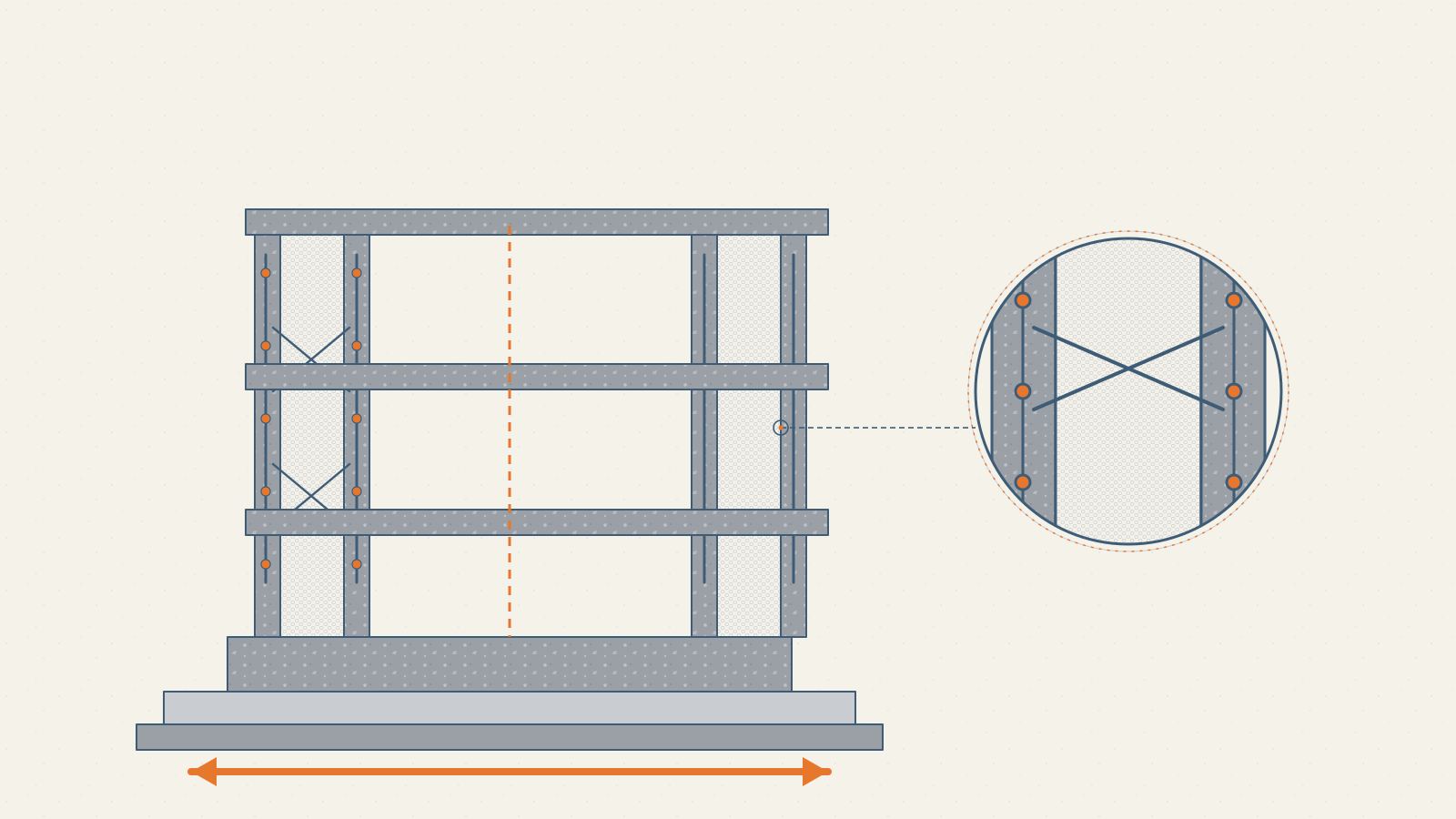
Direct answer. Published laboratory tests of this wall class exist, and they are not one number. A full-scale three-storey sandwich-wall building was shaken at Eucentre in Pavia in December 2011. That paper does not name Emmedue. Emmedue's own specimens were tested separately: subsystems and a two-storey portion on the ENEA table at Casaccia in 2008, and single walls pushed slowly at the University of Pavia. Read each result for the specimen that was actually tested. None of these papers is a record of a house in a real earthquake. [tested]
Two different tests
A shake-table test moves the base of a specimen with a recorded or synthetic earthquake. The report, if it is a damage report, says what cracked. An accelerometric report may only say how the sensors moved.
A cyclic test pushes the top of a wall sideways, slowly, through larger and larger drifts, usually with a constant weight on top. Drift here is the sideways displacement divided by the wall height. It shows stiffness, peak strength, and how the wall comes apart. It does not reproduce earthquake motion.
Where a sentence below rests on a measurement in a report, it is marked [tested]. Where it restates a calculation in the paper, it says so in the sentence. A calculation is not a test.
The three-storey building at Eucentre
Ilaria Ricci, Giada Gasparini, Stefano Silvestri, and Tomaso Trombetti (University of Bologna), Dora Foti (Technical University of Bari), and Salvador Ivorra-Chorro (University of Alicante) describe a shake-table test run at Eucentre in Pavia on 6–7 December 2011. The specimen was a full-scale three-storey structural system of cast-in-situ squat sandwich concrete walls, 5.50 by 4.10 metres in plan and 8.25 metres tall.
The paper's summary, introduction and Section 2 describe the class: a polystyrene support panel, with about 40 mm of concrete sprayed on each face in two passes, left in place as insulation. In the summary, the authors write that these systems are widely used in non-seismic areas or areas of low seismicity, and that their seismic behaviour had not been fully investigated. The paper does not name Emmedue, or any other brand, as the specimen. The result stays with this specimen.
The input was the X component of the record from the Ulcinj, Hotel Albatros station in the 1979 Montenegro earthquake. The paper gives that record a PGA of 0.305 g, then says the record was scaled to increasing PGA levels. White-noise runs were inserted so the team could watch the natural frequency. The authors say the control system needed a long calibration, so the building saw a limited number of seismic runs. [tested]
Through the 1 g seismic test, the measured frequency stayed 10.0 Hz, and the paper says the structure did not show any damage. After a 0.30 g white-noise run the frequency was 8.6 Hz. After a 0.5 g white-noise run it was 8.2 Hz ahead of the second 1.2 g seismic run. [tested]
The crack notes and the closing notes do not use the same words, so both are quoted in substance. Up to the 1 g seismic test, no cracks had developed. After the 0.5 g white-noise run, very little, hairline, not-spread cracks appeared, especially on the top-floor walls. From that white-noise run through the final 1.2 g seismic test, the cracking pattern stayed stable and almost unchanged. The closing section says that after the tests no damage was observed, and that a collapse sequence the designers had calculated was not reached. This page does not flatten those sentences into "only hairline cracks" or into "no damage." The paper calls the dynamic results preliminary. [tested]
The same paper's design section is a calculation, not a measurement. Assuming an amplification factor of 2.5, the authors calculate first yield, in tension of the perpendicular walls, at a spectral acceleration of 0.72 g and a PGA of 0.29 g, with later mechanisms at higher levels up to sliding shear at a calculated PGA of 0.91 g. The reference record was then scaled to nominal PGA levels above those calculated values (a 1.0 g run and two 1.2 g runs), and the paper says the collapse sequence was not observed. The paper reports the nominal scaled levels, not the measured table acceleration, and the calculated values assume a triangular force distribution and an amplification factor of 2.5. The test building was also built with half the system's usual wall reinforcement (φ2.5 mm mesh at 100 × 100 mm instead of 50 × 50 mm). That comparison is about this specimen and this input. It is not a capacity you can copy onto another house.
The paper also compares stiffness with earlier cyclic tests on walls and an H-shaped portion of what it calls the same construction system. Those cyclic specimens had been treated as fully cracked, and a shell model needed a concrete modulus of about one tenth (roughly 3000 MPa) to match them. The shake-table building sat between uncracked and cracked, and a linear shell model needed about half the concrete modulus (roughly 15000 MPa) to match the 10 Hz frequency. The paper attributes those cyclic tests to a campaign by the University of Bologna and the Eucentre labs in Pavia (Trombetti et al. 2010). Its references do not cite the Emmedue wall report in the next section, and the specimen sets differ: that campaign tested 3 × 3 m walls and a two-storey H-shaped portion, while the Emmedue report tests 3 × 3 m and 4 × 3 m single walls. This page does not treat them as the same tests. [tested]
Salvador Ivorra, a co-author, posted a one-minute YouTube clip titled 'Ensayo de edificio sobre mesa sísmica' (test of a building on a seismic table); its description says the building has reinforced-concrete walls. The clip does not say which test it shows. The clip is on this page so you can see a table move. The accelerations, frequencies, and crack notes above come from the paper. The clip does not replace it.
Emmedue on the ENEA table
A February 2009 ENEA report, "Seismic analyses of Emmedue subsystems upon vibrating table: accelerometric readings," lists contributors G. Buffarini, P. Clemente, D. Rinaldis, M. Forni, A. Poggianti, N. Ranieri, S. Serafini, V. Verrubbi, P. Funaro, and M. Azzimato. The copy read for this page is an English file on a distributor site, not an enea.it address. The document itself says it belongs to an Emmedue–ENEA agreement of 10 October 2007.
The specimens were built by Emmedue at the Casaccia dynamic-testing laboratory between 14 July and 8 August 2008. The report covers three of them: a C-shaped wall subsystem tested on 24 October 2008, an H-shaped subsystem tested on 30 October 2008, and a two-storey portion tested in late November 2008 (the report gives both 25–27 and 24–27 November). [tested]
The two-storey portion is 340 cm square in plan and 574 cm tall, with 287 cm between floors. Walls are 15 cm total: an 8 cm polystyrene core, welded mesh (3.5 mm and 2.5 mm wires), about 70 metal connectors per square metre, and spritz-beton faces of 3.5 cm. The ground floor has two door walls, one window wall, and one solid wall. Every upper wall has a window. A load of about 4.5 kN/m² was placed on the first-floor covering. The report says no load was applied to the roof. The walls sit on a 25 × 50 cm reinforced-concrete curb anchored to the table with metal sections. [tested]
The earthquake records were scaled from a peak of 0.05 g up to 0.45 g, in 0.05 g steps. The report says the maximum was set by the table's capacity. This is an accelerometric report. For the seismic runs it says the time histories showed no significant amplification at the top relative to the base, and that the input crossed the structure without significant modification. In the 0.25 g Colfiorito case (its Figure 11) it says the input crossed the structure without significant modification. It also notes a slight reduction of the natural frequencies, which it puts down both to the higher stress level and to input frequencies blending with the structural ones. In the figure captioned Colfiorito 0.45 g (its Figure 12) the X-direction frequency drops to about 10 Hz and the Y-direction frequency to about 9 Hz. The report does state a damage result in one sentence: 'During the entire testing cycle no damage was encountered, even in relation to the highest levels of applied stress.' It does not describe how the model was inspected, and the conclusion is drawn mainly from the frequency readings. A 0.45 g run stopped by the table's capacity for this model is not a proven survival limit of the wall. [tested]
The smaller subsystems do include a damage sentence. The C-shaped model was run with the Colfiorito (1997) and Tolmezzo (1976) records and a synthetic record, up to a peak of 0.8 g. The report says the fastening to the table was inefficient and became more obvious as the demand rose, and that, apart from that attachment, the model passed without suffering evident damage. The H-shaped model reached a peak of 1.0 g, and the report says it also passed without suffering any evident damage. These are wall subsystems with a floor on top, not a house. [tested]
Emmedue walls pushed slowly at Pavia
A separate report, carrying the EUCENTRE name on its title page, works up quasi-static cyclic tests on Emmedue bearing panels. It says the tests were run at the Materials and Structures Laboratory of the Department of Structural Mechanics at the University of Pavia. The PDF used here is hosted on Emmedue's own site, so it is a lab report in the manufacturer's file, not an independent journal article.
The panels in that report are two welded meshes tied by 3 mm connectors, 82 per square metre, with 80 mm of polystyrene at 15 kg/m³ between them, and a concrete face of about 35 mm on each side, placed by a shotcrete-type method. The specimens are single walls: 3.0 by 3.0 m and 4.0 by 3.0 m, with and without a window or a door, each at two constant axial loads. The load is slow cycles of horizontal displacement at the top, to a target drift. [tested]
For the 3.0 by 3.0 m solid wall at 150 kN axial load, the report says the response was essentially linear up to about 125 kN at 0.1% drift, with no evident cracks. At 0.2% drift, horizontal cracks appeared near the bottom corners and the force reached 175 kN. At 0.4% drift the force peaked at 205 kN, with vertical cracks growing from the base at both ends. At 0.6% drift the force stopped rising; the report attributes an immediate drop of about 15% to compression failure of the concrete at the two bottom corners and buckling of the reinforcement there. Some horizontal cracks already through both concrete faces at 0.4% drift also cut the polystyrene at 0.6%. At 1% drift the force was 125 kN, about 40% below the peak. The protocol also included one cycle to 1.5% drift. [tested]
That is one wall, pushed on purpose until it lost strength. The report documents the other seven specimens the same way. This page does not average them into a single ductility number. The introduction says an accurate estimate of the behaviour factor was still in progress, and that a simplified method supplies only an indicative value. The indicative value is not repeated here.
What the tests do not show
- They do not show how an Emmedue house, or any other SCIP house, behaved in a real earthquake. No report read for this page records that.
- They do not show that every panel brand shares the Eucentre 1.2 g runs. The 2011 paper does not name a brand.
- They do not show a roof, a window product, or a foundation. The Pavia work is a wall. The ENEA two-storey portion is a piece of a building on a curb, with no added load on its top slab, run up to 0.45 g (the report says the table's capacity set that maximum for this model; the lighter H subsystem reached 1.0 g in the same report), and written up mainly as sensor readings with a one-sentence no-damage statement.
- They do not replace engineering for a site. A project still has to be engineered for its site and seismic design category, under the evaluation report for the panel and the code the local jurisdiction has adopted. This page does not change any score on this site.