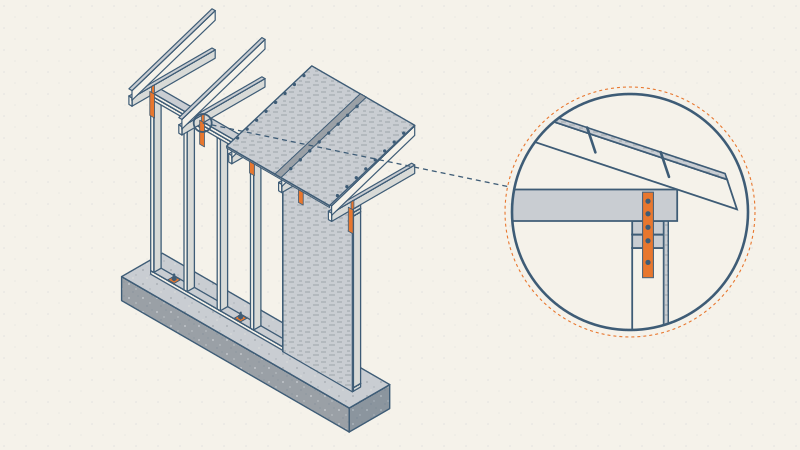
Continuous Load Path: Roof-to-Wall Connections in Florida
How roof-to-wall connections work, how Florida's wind-mitigation form rates them, what a reroof must add under state law, and where FORTIFIED Gold fits.
Photographs are copies stored on this site. Videos stay on YouTube and load only after you press play. A caption stays with what its source says.
IBHS. Continuous load path. Video: Insurance Institute for Business & Home Safety (IBHS). YouTube embed · Watch on YouTubeSimpson Strong-Tie. Animation of connectors and anchors from the roof to the foundation. Shown for the load-path method, not as a product endorsement. Video: Simpson Strong-Tie. YouTube embed · Watch on YouTube
TL;DR: A load path is the chain of connections that carries wind uplift from the roof covering, through the deck and the roof-to-wall connection, down toward the foundation. On Florida's wind-mitigation form, the roof-to-wall link is graded by connector type, and the weakest connection governs.
The direct answer
Find out what you have before paying for anything. Attic access is needed to verify roof-to-wall connections: if there is no attic access, the form records "No attic access" and Citizens treats it as unknown (guide pp. 12-13). Of the retrofits Brookings studied, roof-to-wall was the cheapest, at roughly $2,600 for a typical 1,500 sq ft home, and for the average household the present value of its premium discount exceeded its cost (Brookings WP 109, p. 12). That is the paper's estimate, built from contractor quotes and pricing guides with a wide range around each figure, not a quote for your house.
Connector types on the form (question 6)
The form asks for the weakest roof-to-wall connection (guide p. 12):
Type
What counts, in short
Toenails
Truss or rafter nailed at an angle through to the top plate; also metal connectors that are not installed as intended; or another documented method with a wind uplift capacity of 185 lb or more
Clips
Metal connectors that do not wrap over the truss, or a single strap not meeting the nail positions for wraps, with at least three nails; or a purpose-made connector with a documented capacity of at least 386 lb
Single wraps
A strap wrapping over the truss with at least two nails on one side and one on the other; or a purpose-made connector of at least 535 lb
Double wraps
Two straps, one on each side, with two nails and one nail on opposite sides; or a purpose-made connector of at least 891 lb
Clips, wraps and toenails above the minimum must also meet at least one of the form's "minimal conditions" (for example, at least three nails and no more than a 1/2 in. gap, or free of severe corrosion). Purpose-made connector thresholds require site-specific manufacturer documentation. For homes built on or after 1/1/2002, Citizens enters roof-to-wall as "Not Applicable" unless the inspection shows single wraps or better (guide p. 13). Brookings ranks wraps above clips above toenails for high wind (WP 109 p. 4).
What Florida law makes a reroof add
Section 553.844(3)(b) covers site-built single-family buildings in the wind-borne debris region with an insured value, or a just valuation for property-tax purposes, of $300,000 or more: a roof replacement must incorporate the roof-to-wall techniques. Subsection (2)(b)3 limits those techniques to what can be completed for about 15 percent of the cost of the roof replacement, with priority given to gable ends and to roof corners where the roofing spans are greatest. Brookings describes the mandated roof-to-wall upgrade as capped at 15 percent of the reroofing cost (WP 109 pp. 7, 12). The technical detail is in the Florida Building Commission's rule and code, which we did not read.
FORTIFIED Gold
Gold builds on Silver by requiring a continuous load path from roof to foundation (guide p. 5). In the FORTIFIED mapping tool, Gold is the only level that covers question 6; the tool says to mark at least Answer B for roof-to-wall, and to mark Answer B, C, D or E when the connections are visible and verified from an attic inspection or site-specific documentation (TB FH 2026-02 p. 3). Citizens enters a current Gold certificate as clips unless the inspection shows single or double wraps, and wraps still need photographs (guide p. 13). See FORTIFIED Roof, Silver, and Gold.
Finding out what you have
Collect the roof permit and any product approvals, the year built, and attic photos of the connections for the inspection. See the Florida form.
When not to bother
[judgment] If the home was built in 2002 or later and the form already shows single wraps or better, a retrofit will not change how Citizens enters that line. Ask your insurer how it applies the form before paying for the work.
Questions
Which roof-to-wall connection is strongest on the Florida form?
Double wraps rank highest, then single wraps, then clips, then toenails. The form sets purpose-made connector thresholds of 386 lb (clips), 535 lb (single wraps) and 891 lb (double wraps), and the weakest connection on the roof governs (Citizens guide p. 12).
Do I need to retrofit roof-to-wall connections when I replace my roof?
Sometimes. Under s. 553.844(3)(b), for site-built single-family homes in the wind-borne debris region with an insured or just value of $300,000 or more, a roof replacement must incorporate the roof-to-wall techniques, but the statute does not require them unless they can be completed for 15 percent of the cost of the roof replacement. Whether your address is in the region is a local question.
Does FORTIFIED Roof or Silver cover roof-to-wall connections?
No. Only FORTIFIED Gold covers question 6 on the Florida form, because Gold requires a continuous load path from roof to foundation (TB FH 2026-02 p. 3; Citizens guide p. 5).